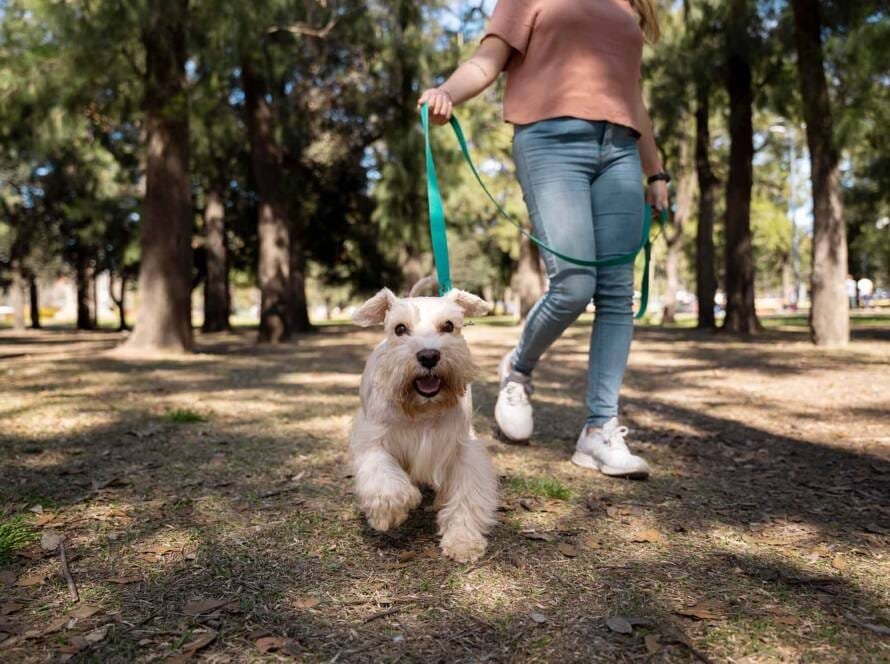


You step outside, your dog spots an interesting patch of grass, and suddenly the walk feels like water-skiing. If this sounds familiar, your dog isn’t necessarily being difficult. Pulling often works. When a dog leans into the leash and reaches something interesting, that experience can teach them to pull again next time.
Understanding the reason behind the behavior helps you choose training that makes sense for both of you.
Dogs and people often walk at different speeds
Most people have somewhere in mind when they go for a walk. Dogs have a different set of priorities. They may want to follow a scent, investigate a tree, change direction, or pause because something caught their attention.
A dog who moves ahead isn’t automatically trying to take charge. In fact, being a little ahead can be perfectly comfortable as long as the leash stays loose. Loose-leash walking is about movement without constant tension, not requiring your dog to stay glued to your leg.
Some dogs pull because they’re excited. Others want to reach an interesting smell or another dog. Some hurry when they’re worried or uncomfortable. That’s why it’s worth looking at your dog’s whole body and the environment, not just the leash.
How pulling becomes a habit
Picture this sequence: your dog smells something ahead, pulls toward it, and you follow because you need to keep walking. They reach the smell. From the dog’s perspective, pulling helped them get what they wanted.
This doesn’t mean you should refuse every sniff or turn the entire walk into a strict lesson. It means we need to change which behavior earns access to interesting things.
A few steps with slack in the leash can be rewarded with a treat, praise, or permission to go sniff. That teaches your dog that staying connected with you opens doors, too.
Not every walk needs the same goal
It can help to separate two types of outings.
A training walk happens in a relatively easy location, where you’re deliberately practicing a few steps of loose leash and rewarding frequently. It may last only a few minutes.
An enrichment walk gives your dog time to sniff and explore at a comfortable pace, using safe equipment and a leash length appropriate to the setting. You can still reinforce a loose leash, but you’re not trying to practice formal walking the entire time.
Both are worthwhile. A dog who is constantly being asked to ignore smells may become more frustrated, while a dog who never practices walking with slack may not learn the skill you need on a busy sidewalk.
Start by observing your dog
Before changing anything, notice where pulling happens. Is it strongest in the first five minutes? On the way to a favorite field? Around other dogs? Only on a particular piece of equipment? Does your dog stop and stiffen before rushing forward?
These details matter. If a dog seems frightened, freezes, suddenly changes their gait, or starts pulling much more than usual, a veterinary check may be appropriate. Training shouldn’t be used to push a dog through pain or fear.
For ordinary excited pulling, start with the easiest possible setting. A quiet driveway or hallway is often better than a crowded trail.
Three things you can try today
Reward the moment the leash loosens. When your dog moves back toward you or creates slack on their own, say a brief marker such as “Yes,” then give a treat near your leg. You’re showing them exactly which choice mattered.
Change direction before the leash tightens. If your dog is about to surge toward something, invite them to turn with you and reward for following. Avoid sudden jerks. The aim is to make the new direction easy and worthwhile.
Use sniffing as a reward. When your dog walks a few steps without pulling, say “Go sniff” and let them investigate a safe spot. Sometimes the environment is a better reward than food.
Keep your expectations small. Five comfortable steps may be real progress. With practice, you can gradually ask for more steps and try slightly busier places.
What won’t solve the underlying problem
Repeated leash corrections, pain-based tools, or pulling the dog into position may suppress movement without teaching a comfortable alternative. They also risk turning walks into stressful experiences.
A well-fitted harness can help with comfort and management, but no piece of equipment automatically teaches loose-leash walking. Dogs still need clear feedback about what works, practice at a manageable difficulty, and reinforcement for the behavior you’re hoping to see.
A better walk starts with a clearer plan
You don’t need to win a tug-of-war with your dog. You need to make staying connected rewarding and set up enough easy practice that the skill has a chance to grow. Let your dog sniff, choose suitable environments, and celebrate the moments when the leash falls into a comfortable curve.
If you’d like help making walks less frustrating, Zen Critter’s Leash Manners program focuses on practical, reward-based skills that you and your dog can use together.