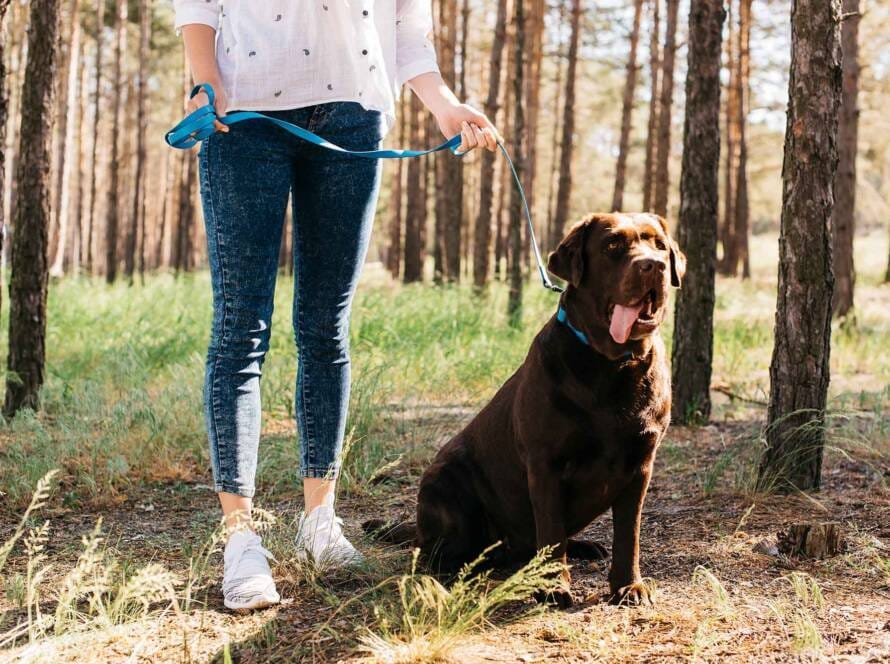


A relaxed walk doesn’t require your dog to march beside your knee. It means you can move together without a tight leash, sudden pulls, or a constant struggle over direction. That’s a skill dogs can learn, and you can teach it without corrections or a strict heel position.
If you’re just getting started, the most important decision is where to practice. Begin somewhere easy enough that your dog can notice you and still enjoy the experience. A quiet room, yard, or familiar driveway is a better classroom than a busy sidewalk full of dogs, food wrappers, and squirrels.
Before you start: make walking comfortable
Choose a well-fitted harness or comfortable collar and a regular leash that allows your dog to move without constant restriction. Many families find a harness useful for everyday walks. Check that it doesn’t rub or interfere with normal movement. Avoid retractable leashes for these early lessons because changing tension makes it harder to show your dog what “loose” means.
Bring small treats your dog likes, and decide on a short marker word such as “Yes.” Say it at the moment your dog does something you want, then give a treat. The marker helps make the connection between the action and the reward.
You don’t need a pile of rules. For the first session, aim for a few steps with slack in the leash.
Step 1: reward a loose leash while standing still
Clip on the leash in a quiet space and stand comfortably. Don’t pull your dog toward you. Watch for any moment the leash forms a soft curve, perhaps because your dog turns back, shifts position, or approaches you.
Say “Yes” and place a treat near your leg. Repeat several times. You’re introducing a simple idea: relaxing the tension pays off.
If your dog is staring at a doorway or straining toward a distraction, increase the distance from it. Make the exercise easier before asking for more.
Step 2: begin moving together
Take one or two steps. If your dog stays within the comfortable length of the leash, mark and reward beside you. Pause, then take another few steps.
Place the reward where you want your dog to be. If you throw every treat far ahead, you may accidentally encourage rushing forward. Giving the treat by your side or slightly behind can make the next repetition easier.
Practice in different directions rather than walking a long, straight line. Turning gently gives your dog chances to notice your movement and reconnect with you.
Step 3: notice the moment before pulling
It’s much easier to help a dog before the leash goes tight than after they’re already charging toward a smell. Look for the little change: their ears point forward, their pace quickens, and they’re about to reach the end of the leash.
Before that happens, cheerfully invite a turn. Move in another direction and reward your dog for coming with you. Don’t jerk the leash or drag them away. You want the turn to feel like an invitation worth following.
If the leash does tighten, stop moving so pulling doesn’t repeatedly lead straight to the destination. Wait for your dog to release some pressure or return toward you, then mark, reward, and move again. If they stay intensely focused on the distraction, calmly increase distance or change the route.
Step 4: let the environment be part of the reward
Treats are useful, but they’re not the only thing a dog wants. Sometimes the greatest reward is permission to sniff a tree or investigate a patch of grass.
Try this: after a few easy steps with a loose leash, say “Go sniff” and walk with your dog toward an interesting, safe spot. You aren’t bribing them to ignore the world. You’re showing them that walking together helps them explore it.
This is especially helpful for dogs who quickly lose interest in treats once they step outside.
Step 5: practice where success is likely
Once your dog can manage several comfortable steps at home, try a quiet outdoor location. Expect to go back to rewarding every few steps at first. New places bring new smells and sounds, so the skill may feel new again.
Increase just one challenge at a time. You might practice farther from home but keep the session short, or stay in a familiar spot while a person walks by at a distance. If your dog begins pulling constantly, the lesson probably became too hard too quickly.
For many dogs, practicing two to five focused minutes at the start of a walk is more useful than trying to maintain perfect leash manners for the entire outing.
Common frustrations
“My dog takes the treat and lunges ahead.” Try rewarding beside or a little behind your leg. Use more frequent rewards and shorter stretches of walking.
“My dog ignores treats outdoors.” Check whether the location is too exciting or stressful. Increase distance, choose a calmer spot, or use permission to sniff as a reward when the dog can still engage.
“It works at home but not at the park.” That’s normal. Dogs don’t automatically apply a new skill everywhere. Go back to easier steps in the new environment.
“Do I have to carry treats forever?” You can gradually vary rewards as the skill improves. Early on, frequent reinforcement is how the dog learns what works. Later, sniffing, moving forward, praise, and occasional food can all help maintain it.
Make room for an actual walk
Your dog deserves opportunities to explore, and you deserve to walk without discomfort. Those goals are compatible. Use short, deliberate training sessions and allow plenty of suitable sniffing time in between. Progress may be uneven, especially during adolescence or in exciting places, but each comfortable stretch matters.
If you want personalized help building these skills, Zen Critter’s Leash Manners program offers reward-based coaching focused on real-life walking with your dog.